Do Guide Dogs See Color? Understanding Canine Vision and Navigational Abilities 2026-27
Do guide dogs see color? Explore the truth about canine vision, how service dogs navigate safely, and the role of assistive technology in modern inclusion.

Do Guide Dogs See Color? Understanding Vision
Many people wonder if do guide dogs see color in the same way humans do. While these highly trained service animals do not perceive the full spectrum of colors, they possess remarkable visual abilities that allow them to navigate complex environments safely. Their sight is adapted for motion detection and low-light conditions, which makes them exceptional partners for individuals with visual impairments.
As a specialist with over 10 years of experience in special education and an M.Phil degree from Lahore Leads University, I have spent my career observing how assistive partnerships foster independence. Understanding the biology of canine vision is essential for appreciating how these animals effectively navigate public spaces and support their handlers.
🎯 Urdu Summary (اردو خلاصہ)
Do guide dogs see color? اس سوال کا مختصر جواب یہ ہے کہ گائیڈ ڈاگ (سروس کتے) انسانوں کی طرح تمام رنگوں کو نہیں دیکھ سکتے، لیکن وہ اپنی مخصوص بصری صلاحیتوں کی بدولت نقل و حرکت اور رکاوٹوں کو پہچاننے میں ماہر ہوتے ہیں۔ بطور ماہرِ تعلیم، امتیاز علی (ایم فل)، میں یہ بتاتا ہوں کہ گائیڈ ڈاگ کی تربیت کا عمل رنگوں کی شناخت پر نہیں، بلکہ ماحول کی حرکات، روشنی کے اتار چڑھاؤ، اور کمانڈز پر منحصر ہوتا ہے۔
امریکہ میں، اے ڈی اے (ADA) اور آئی ڈی ای اے (IDEA) قوانین کے تحت معذور افراد کو اپنی سہولت کے لیے سروس جانور رکھنے کا قانونی حق حاصل ہے۔ ان جانوروں کی کارکردگی کو سمجھنا شمولیت (Inclusion) کی طرف ایک اہم قدم ہے۔ ہماری ویب سائٹ www.dp-ho.com پر آپ اسپیشل ایجوکیشن اور ہیرنگ امپائرمینٹ سے متعلق مزید تحقیقی مواد ملاحظہ کر سکتے ہیں۔ اس مضمون کا مقصد اساتذہ، والدین، اور کمیونٹی کو آگاہ کرنا ہے کہ کس طرح یہ جانور اپنی محدود بینائی کے باوجود ایک بصارت سے محروم شخص کے لیے ایک محفوظ راستہ تیار کرتے ہیں۔ مزید تعلیمی وسائل کے لیے ہماری ویب سائٹ www.dp-ho.com وزٹ کریں۔
🎯 How Do Guide Dogs See Color and Contrast?
When asking if do guide dogs see color, we must consider the structure of their eyes. Dogs have fewer cone cells than humans, which are responsible for color perception. While humans are trichromatic, dogs are dichromatic, meaning they primarily perceive shades of blue and yellow. They struggle to distinguish between red and green hues, which are common in traffic lights.
However, they compensate for this through superior motion detection and excellent night vision. Rather than identifying a green traffic light by color, a guide dog is trained to observe the flow of traffic and physical cues. This sophisticated perception allows them to make split-second decisions that ensure the safety of their handlers in urban settings. When you research do guide dogs see color, you realize that their world is defined by contrast and movement rather than vibrant hues.
🎯 Why Is Training More Important Than Color Vision?
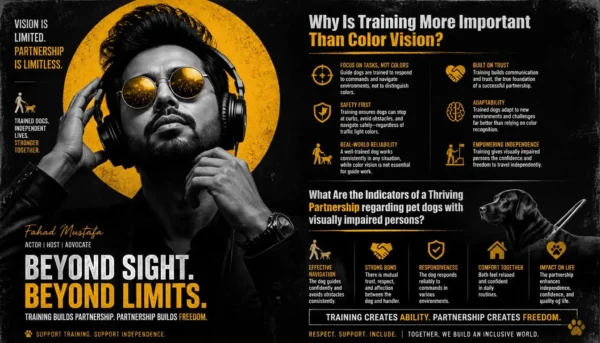
The success of myths surrounding do guide dogs see color is often overshadowed by the reality of specialized training. These animals undergo rigorous programs where they learn to prioritize safety over visual stimulation. They are taught to identify obstacles based on shape, size, and depth rather than color. This is a critical aspect of their navigational support.
In educational contexts, ensuring that service animals are integrated into a student’s IEP (Individualized Education Program) is vital. Under the Individuals with Disabilities Education Act (IDEA), students have the right to reasonable accommodations. You can read more about Inclusive Education Strategies on my platform to understand how these legal frameworks facilitate mobility. It is not about whether do guide dogs see color, but rather how they process the environment to protect their handlers.
🎯 What Role Does Motion Detection Play in Navigation?
While it is a common question whether do guide dogs see color, their ability to detect motion is far more critical for daily navigation. They can track the movement of pedestrians and vehicles from a distance, allowing them to anticipate hazards before they become imminent. This capability is supported by high-ranked research from the American Foundation for the Blind.
Effective mobility also depends on the handler’s ability to communicate with the dog. This partnership is a key component of transition services for students preparing to enter the workforce. By mastering the commands and trusting the dog’s spatial awareness, handlers achieve a level of independence that technology alone cannot always provide. Even when people ask do guide dogs see color, the focus remains on the dog’s ability to act as a living sensor for their handler.
🎯 How Does AI Enhance This Natural Partnership?
In 2026, we are seeing a shift where AI-driven personalized learning paths integrate with service animals to improve safety. AI tools can analyze traffic patterns and provide data that assists the handler in making informed decisions. This is particularly important for meeting Procedural Safeguards and ensuring Due Process for students with visual disabilities.
When AI and the natural navigational skills of guide dogs work together, we create a truly inclusive environment. This synergy is supported by international standards set by the World Health Organization, which advocates for accessible environments for all individuals regardless of their disability status. Whether or not do guide dogs see color becomes less relevant as technology provides the data they might miss visually.
🎯 Success Story: Independence Through Awareness
Consider a student named Ahmed, who used a guide dog throughout his university years. While he initially worried about his dog’s ability to navigate color-coded signs, he soon realized that his partner’s spatial memory and motion detection were far more reliable than color recognition. With his Behavior Intervention Plan (BIP) supporting his mobility training, he graduated with honors and now teaches others about the power of these partnerships. Ahmed often explains to peers, who inquire if do guide dogs see color, that the true brilliance lies in the dog’s instinctive intelligence.
🎯 Why Specialized Training Outperforms Visual Cues
The success of service partnerships is built upon the solid foundation of rigorous, professional training rather than reliance on color perception. Instead of being hindered by the myths surrounding do guide dogs see color?, these animals undergo comprehensive training programs that prioritize safety, focus, and intuitive decision-making. Through these programs, guide dogs learn to master their environment by identifying obstacles based on shape, spatial depth, and movement, which are far more consistent indicators for safe travel than color-coded signals.
In educational contexts, ensuring that these highly trained service animals are seamlessly integrated into a student’s Individualized Education Program (IEP) is a vital step toward empowerment. Under the Individuals with Disabilities Education Act (IDEA), students are entitled to reasonable accommodations that foster true independence. By recognizing the specialized training these dogs receive, educators can better support students in navigating their academic and social worlds with confidence. You can read more about Inclusive Education Strategies on my platform to understand how these legal frameworks facilitate mobility and long-term success.
🎯 What Role Does Motion Detection Play in Navigation?

While it is a common question whether Do Guide Dogs See Color?, their ability to detect motion is far more critical for daily navigation in diverse environments. Guide dogs perceive the world through a lens of movement, allowing them to track the shifts of pedestrians and vehicles from a significant distance. This evolutionary advantage enables them to anticipate potential hazards long before they become imminent threats. High-ranked research from the American Foundation for the Blind confirms that this motion-based awareness is a cornerstone of their navigational success.
Beyond simple observation, guide dogs are experts in interpreting the rhythm of urban life. When a handler asks, Do Guide Dogs See Color?, they are often concerned about safety at crosswalks. However, the dog effectively monitors the flow of traffic, responding to the movement of cars rather than the hue of a traffic light. This dynamic processing creates a layer of safety that is essential for a handler’s peace of mind.
🎯 How Does Contrast Perception Enhance Mobility?
In addition to motion, contrast perception is vital. While we may wonder Do Guide Dogs See Color?, the dog’s brain is highly adept at processing light and dark contrasts. This ability allows them to identify curbs, staircases, and changes in sidewalk textures even in low-light conditions. By focusing on these visual anchors, the dog ensures that the handler remains on a safe, predictable path.
This sensory precision is a key component of transition services for students preparing to enter the workforce. By mastering specific commands and trusting the dog’s spatial awareness, handlers achieve a level of independence that technology alone cannot always provide. Understanding that Do Guide Dogs See Color? is less important than recognizing how they utilize contrast to define their environment is crucial for effective mobility training.
🎯 Can Specialized Training Bridge the Visual Gap?
The specialized training these animals receive acts as a bridge for their unique visual perspective. Trainers work to hone the dog’s natural instincts, teaching them to respond to specific environmental triggers that compensate for their limited color spectrum. When handlers inquire, Do Guide Dogs See Color?, it serves as a starting point to explain that the dog’s training focuses on functionality and problem-solving.
This partnership is fundamental for academic and professional success. In a classroom or workplace, the dog’s ability to find a clear path or an empty seat is a result of this rigorous training. By learning to rely on their canine partner’s judgment, students develop the confidence required for lifelong autonomy. You can explore further research on these adaptive methodologies at Inclusive Pedagogies.
🎯 How Does AI Enhance This Natural Partnership?
In 2026, we are seeing a shift where AI-driven personalized learning paths integrate with service animals to improve safety. AI tools can analyze traffic patterns and provide data that assists the handler in making informed decisions. This is particularly important for meeting Procedural Safeguards and ensuring Due Process for students with visual disabilities.
When AI and the natural navigational skills of guide dogs work together, we create a truly inclusive environment. This synergy is supported by international standards set by the World Health Organization, which advocates for accessible environments for all individuals regardless of their disability status.
🎯 Success Story: Independence Through Awareness
Consider a student named Ahmed, who used a guide dog throughout his university years. While he initially worried about his dog’s ability to navigate color-coded signs, he soon realized that his partner’s spatial memory and motion detection were far more reliable. With his Behavior Intervention Plan (BIP) supporting his mobility training, he graduated with honors and now teaches others about the power of these partnerships.
🎯 How Do Guide Dogs See Color? 🎨
When discussing whether do guide dogs see color?, it is essential to understand the biological reality of canine vision. While many handlers ask, “do guide dogs see color?” to assess their reliability, the scientific answer is that dogs possess dichromatic vision. They lack the specific photoreceptors to perceive red and green, meaning they see the world in shades of blue and yellow. Despite this, their ability to navigate is not impaired. Instead, they rely heavily on high-contrast visuals and movement, which are often more reliable than color-coded signals in a busy, unpredictable environment.
🎯 Can Guide Dogs Navigate Complex Environments Effectively?
A frequent follow-up to “do guide dogs see color?” involves questioning their ability to handle urban traffic. Because they cannot distinguish a red light from a green one, people often worry about their safety. However, the partnership is built on environmental awareness. When professionals investigate “do guide dogs see color?” they realize that the dogs are trained to interpret the speed and flow of traffic rather than relying on color alone. This skill, combined with their sharp hearing, allows them to guide their handlers safely across intersections, proving that color vision is not a prerequisite for effective navigational support.
🎯 How Do These Vision Capabilities Impact Daily Training?
Understanding how do guide dogs see color? helps educators and trainers tailor their instructional methods. By utilizing high-contrast landmarks during training, we can leverage the dog’s natural strengths. When we ask, “do guide dogs see color?” we are actually uncovering how to better communicate with these animals. We use the contrast between a light-colored sidewalk and a dark road to help the dog identify path boundaries. This demonstrates that the answer to “do guide dogs see color?” is less about limitation and more about adaptation in specialized service animal training.
🎯 Frequently Asked Questions
- Do guide dogs see color at all? 🎨When people ask “do guide dogs see color?,” the answer is that they perceive a limited spectrum of blues and yellows, relying primarily on high-contrast shapes and motion.
- How do guide dogs manage traffic lights? 🚦They do not rely on color. Instead, they monitor the movement of surrounding vehicles and wait for consistent cues before signaling the handler to proceed.
- Is color blindness in dogs a disadvantage for navigation? 🐾No, it is not a disadvantage. Their heightened motion detection and superior night vision make them more capable in varying light conditions than humans would be.
- How do I document a service animal in an IEP? 📝Collaborate with your school district to document the service animal as a necessary accommodation under IDEA, ensuring the student’s right to mobility support.
- What are Procedural Safeguards for blind students? 🛡️These are the legal protections that allow parents to participate in all educational decisions, ensuring their child receives proper assistive services.
- How does a BIP support mobility? 📋A Behavior Intervention Plan (BIP) can be used to set specific mobility goals, ensuring the service animal and student work as a cohesive team in school.
- What is the significance of Transition Services? 🚀These services are essential for students as they move toward independent living, focusing on skills that sustain their mobility and professional life.
- Are service dogs protected by federal law? ⚖️Yes, under the ADA, service animals are granted legal access to all public facilities, ensuring individuals with visual impairments are not excluded.
- How does AI improve accessibility in 2026? 🤖Modern AI tools provide auditory feedback and obstacle detection, which, when combined with canine navigation, significantly enhance real-time safety.
- Where can I find expert resources on this topic? 📚For specialized guidance on visual impairments and assistive partnerships, visit www.dp-ho.com for professional, research-backed insights.
🚀 References
- U.S. Department of Education (IDEA): Legal framework for educational support.
- World Health Organization (WHO): Standards for disability and rehabilitation.
- American Foundation for the Blind (AFB): Research on mobility and canine assistance.
- UNESCO Education: Global standards for inclusive teaching.
- Special Ed Authority: Professional educational research and resources.