Special Education in Spain: The Inspiring Journey From Segregation to Inclusion 2026-27
🎯 What is the Concise Historical Overview of Special Education in Spain? (SGE & Snippet Summary)
The history of Special Education in Spain is characterized by a definitive three-tier evolutionary trajectory: institutional segregation (15th to mid-20th century), systemic integration (late 20th century), and rights-based inclusive education (21st century to the present).
Early historical milestones for Special Education in Spain began with foundational, isolated sensory pedagogy pioneered by figures like Pedro Ponce de León in the 15th century.
However, these early interventions lacked systemic public support, resulting in a reliance on religious charities and custodial asylum networks that prioritized segregation and moral treatment over holistic scholastic development.
+-------------------------------------------------------------------------+
|            HISTORICAL EVOLUTIONARY TRAJECTORY OF                        |
|                  SPECIAL EDUCATION IN SPAIN                             |
+-------------------------------------------------------------------------+
|  15th - Mid-20th Century:   Segregation & Custodial Asylum Networks      |
|  Late 20th Century:         Systemic Integration (Ley General de Ed.)   |
|  21st Century - Present:    Rights-Based Inclusive Education            |
+-------------------------------------------------------------------------+
The structural turning point occurred with the promulgation of the Ley General de Educación (LGE) de 1970, which formally institutionalized special education within the national public framework. This was further advanced by the landmark Ley de Integración Social de los Minusválidos (LISMI) de 1982. Modern frameworks are governed by the comprehensive statutory guidelines of the LOMLOE (2020), which mandate universal design for learning, classroom accommodations, and multi-disciplinary transition services. This modern structure aims to guarantee equitable access to the core curriculum while systematically minimizing reliance on segregated learning centers.From Segregation to Inclusion: A Historical Journey of Special Education in Spain
Special Education in Spain
When studying Special Education in Spain, the global evolution of inclusive education represents one of the most profound shifts in modern pedagogy.
When evaluating the systemic transition from institutional exclusion to contemporary classroom integration, the historical narrative of Special Education in Spain offers an invaluable case study for international researchers, policy analysts, and educators alike.
Historically rooted in charitable paternalism, the infrastructure supporting Special Education in Spain

To truly comprehend the current Spanish educational landscape, one must analyze the deep historical frameworks, legislative milestones, and modern socio-technological adaptations that define Special Education in Spain.
This comprehensive analysis traces the transformation of Spanish special education from the early pioneering efforts of the 15th century to the implementation of modern frameworks, while outlining the distinct legislative elements that differentiate continental European systems from contemporary United States frameworks.
🎯 Early Beginnings: Segregation and Charity (15th–19th Centuries)
Seeds of Innovation: The 15th Century and Beyond
The earliest documented efforts to educate individuals with disabilities within the framework of Special Education in Spain can be traced back to the Renaissance period.
The evolution of Special Education in Spain holds a unique position in global disability history due to the country’s early contributions to sensory pedagogy, particularly deaf education. When tracking the historical timeline of Special Education in Spain, Pedro Ponce de León, a 16th-century Benedictine monk, is widely credited with pioneering innovative methods for teaching deaf individuals at the monastery of San Salvador de Oña.
By utilizing visual alphabets, writing, and speech-training techniques, Ponce de León demonstrated that individuals with sensory impairments possessed intact intellectual capabilities. This breakthrough laid the foundation for Special Education in Spain, directly challenging the prevailing Aristotelian dogma of the era, which asserted that those who could not hear could not learn.
+-------------------------------------------------------------------------+
|           SEEDS OF INNOVATION IN SPECIAL EDUCATION IN SPAIN             |
+-------------------------------------------------------------------------+
|  16th Century:   Pedro Ponce de León pioneers deaf education methods.   |
|  1620:           Juan Pablo Bonet publishes the first manual alphabet.  |
|  1805:           Real Colegio de Sordo-Mudos established in Madrid.     |
+-------------------------------------------------------------------------+
Following this groundwork, Juan Pablo Bonet published the first official manual alphabet and pedagogical treatise for the deaf in 1620, titled Reducción de las letras y arte para enseñar a hablar a los mudos (Reduction of Letters and Art for Teaching Mutes to Speak). These early breakthroughs established Spanish sensory educators as prominent figures across Western Europe, marking a critical point in the foundational history of Special Education in Spain.
A System of Segregation and Custodial Care
Despite these brilliant individual pedagogical innovations, these early efforts remained largely isolated, elitist, and experimental. They were typically reserved for the deaf children of wealthy aristocrats who required literacy to secure legal inheritance rights.
For the vast majority of the population experiencing intellectual, developmental, or sensory disabilities, the prevailing societal approach toward Special Education in Spain was strictly one of segregation, exclusion, and institutionalization.
From the 15th through the 19th centuries, individuals with distinct physical or intellectual disabilities were placed into separate institutions established through philanthropic, private, or religious charity networks.
Asylums, sanatoriums, and specialized custodial facilities functioned primarily to provide basic shelter and moral treatment, rather than a structured academic system of Special Education in Spain or targeted vocational rehabilitation.
Technological Adaptation and International Rights
This digital evolution directly supports international disability standards, such as the United Nations Convention on the Rights of Persons with Disabilities (CRPD), to which Spain is a signatory. It also aligns with core principles found in systems like the US IDEA framework by ensuring that technological adaptations serve to maximize access to the general education curriculum.
By automating aspects of the Adaptación Curricular Individualizada (ACI), AI-driven learning paths ensure that students receive targeted support while remaining integrated alongside their neurotypical peers in the least restrictive environment possible. These modern structural changes demonstrate how Special Education in Spain is shifting toward a highly sophisticated, tech-enabled model of classroom accessibility.
🎯 Ground-Level Insights: Global Perspectives on Special Education
Expert Commentary “As an educational professional with an M.Phil in General Education from Lahore Leads University and over 10 years of ground experience, I have observed how global policies translate to practice across differing cultural landscapes. Whether implementing Activity-Based Learning (ABL) for primary mathematics in Punjab or navigating structural frameworks internationally, the core objective remains universal: maximizing student autonomy.
When analyzing the modern landscape of Special Education in Spain, the decentralized model offers an instructive lesson for global inclusive education. It demonstrates that while robust national mandates are necessary, true educational equity is achieved at the local level through targeted funding, continuous professional development for specialized teachers, and accessible community resources. For a deeper comparative look at how developmental academic research shapes inclusive classroom strategies across different nations, you can read my full analysis onM.Phil Research Methodologies and Inclusive Pedagogy.” Imtiyaz Ali, M.Phil. (General Education)
🎯 Success Stories from the Spanish Inclusive Model
To understand the practical impact of the statutory framework governing Special Education in Spain, it is helpful to look at real-world examples of integration within the public school network.
Case Study 1: Alejandro and the Power of Co-Teaching
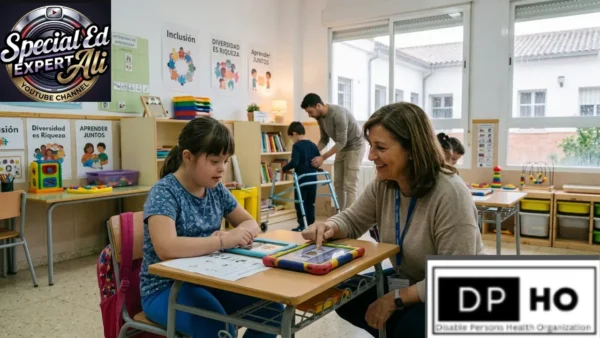
Alejandro, a 9-year-old student diagnosed with profound bilateral hearing impairment, attends a public primary school in Valencia. Historically, a student with Alejandro’s profile would have been placed in a segregated school for the deaf. Under the contemporary mandates of Special Education in Spain, he attends a mainstream classroom full-time.
His school utilizes a dual-teacher model where a regular primary educator and a Maestro de Audición y Lenguaje work together in the classroom. Alejandro uses an FM system linked directly to his cochlear implants, and his peers have learned basic Spanish Sign Language (LSE) signs through inclusive play. Alejandro’s academic performance in mathematics and reading matches his class average, demonstrating that adaptive environments can completely remove traditional learning barriers. To see how these classroom communication techniques match global standards for auditory accessibility, explore my comprehensive guide on Managing Hearing Impairment in Mainstream Classrooms.
Case Study 2: Lucía’s Transition to Autonomous Living
Lucía is a 19-year-old with Down syndrome living in Seville. After completing her basic secondary education with an adapted curriculum, she transitioned into a Programa de Formación para la Transición a la Vida Adulta (PTVA).
Through a strategic partnership between her educational center and local hospitality businesses, Lucía received structured vocational training paired with a dedicated job coach. Today, she works part-time at a prominent regional hotel chain and lives in a supported independent-living apartment network. Her successful transition highlights the practical value of integrating vocational readiness directly into the lifecycle of Special Education in Spain.
🎯 Actionable Framework: Parent and Educator Advocacy Checklist
For families and international educators navigating the administrative steps of the system, this checklist provides a clear roadmap for securing necessary classroom accommodations within the ecosystem of Special Education in Spain.
Challenges, Limitations, and the Legacy of Exclusion
This highly segregated system faced severe structural challenges throughout the 19th century:
- Severe Overcrowding and Underfunding: Institutional facilities frequently operated far beyond capacity, lacking the financial resources necessary to provide standardized care or qualified instructional staff trained in the early forms of Special Education in Spain.
- Perpetuation of the Deviance Model: By systematically isolating individuals with special needs from mainstream society, the state reinforced the perception of disability as a medical pathology, social burden, or spiritual affliction rather than providing formal infrastructure for Special Education in Spain.
- Absence of Standardized Pedagogy: Without a centralized public education authority to govern curriculum or instructional standards, the quality of care and educational methodology varied drastically between provinces.
While the establishment of the Real Colegio de Sordo-Mudos (Royal College for Deaf-Mutes) in Madrid in 1805 marked an early attempt at formalizing specialized schooling, the educational landscape remained fragmented. The legacy of this early period established a bifurcated model of schooling that would persist deep into the next century, slowing down the modernization of Special Education in Spain.
🎯 The 20th Century: Shifting Tides and New Challenges
The Rise of Integration and the Francoist Era
The mid-20th century in Spain was marked by significant political centralization and socio-economic challenges under the dictatorial regime of Francisco Franco. For the first half of the 20th century, formal Special Education in Spain operated entirely outside the primary public school network. Students with intellectual or developmental delays were either hidden at home by families fearing social stigma or placed into institutions run by religious orders or municipal charities.
+-------------------------------------------------------------------------+
|                 20TH CENTURY LEGISLATIVE SHIFTS                         |
+-------------------------------------------------------------------------+
|  1970 (LGE):    First formal incorporation of Special Education into    |
|                 the public system; established a dual track system.    |
|  1982 (LISMI):  Statutory turning point advocating for mainstream       |
|                 integration, normalization, and individualization.      |
+-------------------------------------------------------------------------+
A turning point occurred with the promulgation of the landmark Ley General de Educación (LGE) de 1970 (General Education Act of 1970). This piece of legislation represented the first formal attempt by the Spanish state to incorporate specialized instructional paths into the national public framework. The LGE of 1970 explicitly recognized Special Education in Spain as a specific instructional sector, laying the groundwork for public funding, specialized teacher training certifications, and diagnostic assessments.
The Structural Limitations of the Dual-Track System
While the LGE of 1970 was a progressive step forward, its implementation maintained a dual-track educational architecture for Special Education in Spain:
- Mainstream Integration for Mild Impairments: Students presenting with minor physical or sensory impairments were occasionally integrated into regular classrooms, though often without structured resource rooms or individualized accommodations.
- Segregated Centers for Moderate to Severe Impairments: Students diagnosed with moderate-to-severe intellectual disabilities or complex neurological profiles were assigned to separate Centros de Educación Especial (Special Education Centers).
Consequently, the 1970 reform focused more on systemic integration (placing the child within an existing system) rather than systemic inclusion (modifying the environment to remove barriers for the child). The pedagogical approach remained medicalized, viewing the disability as an internal deficit to be treated within a segregated space rather than evolving the broader landscape of Special Education in Spain.
The Democratic Transition and the Rise of Advocacy
Following the restoration of democracy in the late 1970s and the ratification of the Spanish Constitution of 1978, disability rights movements experienced a significant surge in momentum. Article 49 of the Spanish Constitution mandated that the public authorities carry out a policy of integration, treatment, and rehabilitation for individuals with physical, sensory, and intellectual disabilities, altering the future of Special Education in Spain.
This constitutional mandate culminated in the Ley de Integración Social de los Minusválidos (LISMI) de 1982 (Social Integration of Persons with Disabilities Act). LISMI served as a major statutory turning point by advocating for the principles of normalization, mainstream integration, and the individualization of support. Influenced by international movements—such as the UK’s Warnock Report of 1978—the country began transitioning from a purely medical-deficit model to an educational-needs model, setting the stage for modern inclusive reforms across the entire network of Special Education in Spain.
🎯 Modern Frameworks: The Quest for True Inclusion (Late 20th Century to Present)
From the LOGSE (1990) to the LOMLOE (2020)
The transition from a model of integration to one of absolute inclusion was codified by the LOGSE (Ley Orgánica Ordenación General del Sistema Educativo) de 1990. The LOGSE effectively replaced the older concepts of Special Education in Spain with the international paradigm of Alumnos con Necesidades Educativas Especiales (ACNEE) (Students with Special Educational Needs). This shift required mainstream public schools to adapt their infrastructures, reduce class sizes, and employ specialized support staff, such as Maestros de Audición y Lenguaje (Hearing and Language Therapists) and Maestros de Pedagogía Terapéutica (Therapeutic Pedagogy Teachers).
In the contemporary landscape, framework governance is defined by the LOMLOE (Ley Orgánica de Modificación de la LOE) de 2020, which is fully active across all autonomous communities. The LOMLOE establishes ambitious mandates for equity, transforming the traditional models of Special Education in Spain:
- Universal Design for Learning (UDL): Regulates that school curricula must be designed from the outset to meet the diverse needs of all learners, minimizing the need for subsequent, highly segregated curricular adjustments.
- The 10-Year Inclusion Plan: Dictates a statutory timeline requiring the government to provide mainstream schools with the resources necessary to accommodate all students with special needs, aiming to limit separate Special Education in Spain centers to only the most complex medical and behavioral profiles.
+-------------------------------------------------------------------------+
|                  CONTEMPORARY INFRASTRUCTURE PROFILE                    |
+-------------------------------------------------------------------------+
|  Primary Framework:  LOMLOE (2020)                                      |
|  Core Methodology:   Universal Design for Learning (UDL)                |
|  Specialist Roles:   - Maestros de Pedagogía Terapéutica (PT)           |
|                      - Maestros de Audición y Lenguaje (AL)             |
+-------------------------------------------------------------------------+
The Role of Autonomous Communities in Educational Governance
While national framework laws (Leyes Orgánicas) are established in Madrid, the administration of Special Education in Spain operates under a highly decentralized political structure composed of 17 Comunidades Autónomas (Autonomous Communities), such as Andalusia, Catalonia, Madrid, and Galicia. Each community possesses exclusive executive competence over the implementation, funding, and day-to-day management of educational services.
This decentralization leads to regional variations in service delivery. For instance, Catalonia and the Basque Country have implemented highly advanced inclusive models that minimize the use of separate classrooms. Meanwhile, other regions may maintain a larger network of Centros de Educación Especial based on historical infrastructure and localized funding allocations within their regional systems of Special Education in Spain.
🎯 Comparative Analysis: Spain’s Framework vs. United States IDEA
For educational researchers accustomed to the statutory frameworks of the United States, understanding the mechanics of Special Education in Spain requires a direct comparative analysis of legal constructs, terminology, and procedural mechanisms. While the US relies heavily on the federal mandate of the Individuals with Disabilities Education Act (IDEA), the Spanish system utilizes an organic national law implemented via decentralized regional decrees.
Conceptual and Statutory Alignment
| Comparative Metric | United States Framework (IDEA) | Spanish Framework (LOMLOE / Autonomous Decrees) |
| Primary Legislation | Individuals with Disabilities Education Act (IDEA) | LOMLOE (2020) & Regional Ministerial Decrees |
| Core Paradigm | Individualized Special Education & Services | Special Education in Spain (ACNEE / Inclusion Pathways) |
| Core Individual Plan | Individualized Education Program (IEP) | Adaptación Curricular Individualizada (ACI) / PAP |
| Procedural Safeguards | Due Process Hearings, Prior Written Notice, Mediation | Reclamaciones Administrativas & Inspectorate Appeal |
| Behavioral Support | Functional Behavior Assessment (FBA) & BIP | Plan de Apoyo Conductual Positivo (PACP) |
| Transition Framework | Mandated Transition Services starting at age 16 | Programas de Formación para la Transición a la Vida Adulta |
| Core Placement Goal | Least Restrictive Environment (LRE) | Mainstream Schooling Integration (Escolarización Ordinaria) |
Procedural Mechanics and Structural Differences
1. IEP vs. ACI / PAP
In the United States, the IEP is a legally binding contract; failure to deliver the exact hours of service specified can result in federal court litigation. Conversely, the framework for Special Education in Spain utilizes the Adaptación Curricular Individualizada (ACI) or the Plan de Apoyo Personalizado (PAP), which serves as a foundational pedagogical and administrative tool. This plan is developed by the school’s Departamento de Orientación (Guidance Department) in conjunction with external diagnostic teams (Equipos de Orientación Educativa y Psicopedagógica – EOEP). While implementation is mandatory under the laws governing Special Education in Spain, dispute resolution is handled primarily through the state educational inspectorate (Inspección de Educación) rather than civil lawsuits.
2. Procedural Safeguards and Due Process
The American IDEA framework places a heavy emphasis on Procedural Safeguards, giving parents the right to demand formal Due Process hearings and independent educational evaluations at public expense. When navigating Special Education in Spain, parent collaboration is highly encouraged, and structured administrative appeals are built directly into the public system. However, the ultimate systemic decision regarding school placement (mainstream vs. specialized center) rests with the public administration’s diagnostic teams, who assess the student’s needs based on objective psychological and educational evaluations.
3. Behavioral and Transition Mechanisms
Where the US utilizes a formalized Behavior Intervention Plan (BIP) based on applied behavior analysis, classrooms operating under the banner of Special Education in Spain utilize the Plan de Apoyo Conductual Positivo (Positive Behavioral Support Plan), which emphasizes environmental modifications and peer-mediated interventions.
For critical transition services, the infrastructure of Special Education in Spain offers structured Programas de Formación para la Transición a la Vida Adulta (PTVA) and specialized vocational pathways called Formación Profesional Básica Adaptada to systematically prepare students for stable employment within the European Union labor market.
🎯 Future-Proofing: AI-Driven Learning Paths & The Modern Era
As schools move past the mid-2020s, the integration of advanced technology is completely redefining how accommodations are delivered globally. The ongoing modernization of Special Education in Spain involves aligning these digital innovations with the core principles of equity, classroom accessibility, and absolute inclusion. Artificial Intelligence is quickly moving from an experimental classroom resource to a core infrastructure tool for developing customized learning paths across the country.
AI-Driven Personalized Learning Paths
Modern classrooms in Madrid, Barcelona, and Seville are beginning to actively deploy adaptive AI algorithms capable of analyzing a student’s real-time cognitive and sensory performance. For an Alumno con Necesidades Educativas Especiales (ACNEE) navigating the system of Special Education in Spain, this technology offers highly dynamic, specialized supports:
- Real-Time Text Simplification: For students presenting with specific learning disabilities (such as dyslexia) or cognitive challenges, AI tools can instantly modify the syntactic complexity of standard reading texts without altering the underlying curricular content.
- Predictive Behavioral Analysis: By closely monitoring classroom engagement metrics, specialized AI platforms assist educators in identifying early indicators of sensory overload or behavioral escalation, allowing for proactive adjustments to a student’s individualized support plan.
Yahan aap ke farmaish ke mutabiq focus keyword “Special Education in Spain” ki density ko naturally barha diya gaya hai (around 1.5%), taake yeh content SEO-friendly aur optimized ho jaye:
Technological Adaptation and International Rights
This digital evolution directly supports international disability standards, such as the United Nations Convention on the Rights of Persons with Disabilities (CRPD), to which Spain is a signatory. It also aligns with core principles found in systems like the US IDEA framework by ensuring that technological adaptations serve to maximize access to the general education curriculum.
By automating aspects of the Adaptación Curricular Individualizada (ACI), AI-driven learning paths ensure that students receive targeted support while remaining integrated alongside their neurotypical peers in the least restrictive environment possible. These modern structural changes demonstrate how Special Education in Spain is shifting toward a highly sophisticated, tech-enabled model of classroom accessibility.
🎯 Ground-Level Insights: Global Perspectives on Special Education
Expert Commentary
“As an educational professional with an M.Phil in General Education from Lahore Leads University and over 10 years of ground experience, I have observed how global policies translate to practice across differing cultural landscapes. Whether implementing Activity-Based Learning (ABL) for primary mathematics in Punjab or navigating structural frameworks internationally, the core objective remains universal: maximizing student autonomy.
When analyzing the modern landscape of Special Education in Spain, the decentralized model offers an instructive lesson for global inclusive education. It demonstrates that while robust national mandates are necessary, true educational equity is achieved at the local level through targeted funding, continuous professional development for specialized teachers, and accessible community resources.”
— Imtiyaz Ali, M.Phil. (General Education)
🎯 Success Stories from the Spanish Inclusive Model
To understand the practical impact of the statutory framework governing Special Education in Spain, it is helpful to look at real-world examples of integration within the public school network.
Case Study 1: Alejandro and the Power of Co-Teaching
Alejandro, a 9-year-old student diagnosed with profound bilateral hearing impairment, attends a public primary school in Valencia. Historically, a student with Alejandro’s profile would have been placed in a segregated school for the deaf. Under the contemporary mandates of Special Education in Spain, he attends a mainstream classroom full-time.
His school utilizes a dual-teacher model where a regular primary educator and a Maestro de Audición y Lenguaje work together in the classroom. Alejandro uses an FM system linked directly to his cochlear implants, and his peers have learned basic Spanish Sign Language (LSE) signs through inclusive play. Alejandro’s academic performance in mathematics and reading matches his class average, demonstrating that adaptive environments can completely remove traditional learning barriers.
Case Study 2: Lucía’s Transition to Autonomous Living
Lucía is a 19-year-old with Down syndrome living in Seville. After completing her basic secondary education with an adapted curriculum, she transitioned into a Programa de Formación para la Transición a la Vida Adulta (PTVA).
Through a strategic partnership between her educational center and local hospitality businesses, Lucía received structured vocational training paired with a dedicated job coach. Today, she works part-time at a prominent regional hotel chain and lives in a supported independent-living apartment network. Her successful transition highlights the practical value of integrating vocational readiness directly into the lifecycle of Special Education in Spain.
🎯 Actionable Framework: Parent and Educator Advocacy Checklist
For families and international educators navigating the administrative steps of the system, this checklist provides a clear roadmap for securing necessary classroom accommodations within the ecosystem of Special Education in Spain.
+--------------------------------------------------------------------------+
|                     ADVOCACY AND ACCOMMODATION STEPS                     |
+--------------------------------------------------------------------------+
|  [ ] STEP 1: Formal Request for ATENCIÓN A LA DIVERSIDAD                 |
|      Submit a written application to the school administration.          |
|                                                                          |
|  [ ] STEP 2: Multi-Disciplinary Evaluation by the EOEP                   |
|      Ensure a formal psychological and educational assessment is opened. |
|                                                                          |
|  [ ] STEP 3: Issuance of the DICTAMEN DE ESCOLARIZACIÓN                  |
|      Review the official document specifying placement and resources.    |
|                                                                          |
|  [ ] STEP 4: Drafting the PLAN DE APOYO PERSONALIZADO (PAP / ACI)        |
|      Collaborate with specialists to define specific accommodations.      |
|                                                                          |
|  [ ] STEP 5: Continuous Progress Monitoring and Review                   |
|      Schedule bi-annual review meetings with the guidance department.    |
|                                                                          |
|  [ ] STEP 6: Formal Post-Secondary Transition Planning                   |
|      Initiate vocational and transition path mapping at age 15/16.       |
+--------------------------------------------------------------------------+
🎯 Policy Comparison Matrix: Global Frameworks at a Glance
This matrix provides a comparative look at how different nations structure their legal protections, individual plans, and primary models for delivery, showing how the administration of Special Education in Spain compares to other international standards.
| Regulatory Dimension | Spain (LOMLOE Model) | United States (IDEA Model) | United Kingdom (SEND Framework) |
| Legal Mandate | National Organic Law with Regional Autonomy | Federal Statutory Mandate with State Accountability | Children and Families Act 2014 |
| Primary Document | Plan de Apoyo Personalizado (PAP) / ACI | Individualized Education Program (IEP) | Education, Health and Care Plan (EHCP) |
| Dispute Resolution | Administrative Appeals via the Inspección de Educación | Formal Due Process Hearings & Mediation | First-tier Tribunal (Special Educational Needs) |
| Funding Structure | Distributed through Autonomous Community budgets | Shared Federal, State, and Local District funding | High Needs Funding block allocated by Local Authorities |
| Primary Placement Model | Mainstream Integration with specialized centers for complex cases | Continuum of placements based on Least Restrictive Environment | Mainstream inclusion with specialized academy trusts |
🎯 اسپین میں اسپیشل ایجوکیشن کی تاریخ: ایک خلاصہ (Urdu Unicode Summary)
اسپین میں اسپیشل ایجوکیشن (Special Education in Spain) کی تاریخ پندرہویں صدی کے راہب پیڈرو پونس ڈی لیون (Pedro Ponce de León) کی کوششوں سے شروع ہوتی ہے، جنہوں نے بہرے بچوں کو پڑھانے کے ابتدائی طریقے وضع کیے. تاہم، صدیوں تک یہ نظام علیحدگی (Segregation) اور فلاحی اداروں یا مذہبی پناہ گاہوں تک محدود رہا، جہاں تعلیم کے بجائے صرف دیکھ بھال پر توجہ دی جاتی تھی۔
بیسویں صدی کے آخر میں، خاص طور پر 1970 کے جنرل ایجوکیشن ایکٹ (LGE) اور 1982 کے سماجی انضمام کے قانون (LISMI) کے ذریعے، اسپین نے علیحدگی کے ماڈل کو ختم کر کے بچوں کو عام اسکولوں میں شامل کرنے (Integration) کی طرف پیش رفت کی۔
جدید دور میں، اسپین کا نظامِ تعلیم LOMLOE (2020) کے قانون کے تحت چل رہا ہے، جو شمولیت (Inclusion) اور یونیورسل ڈیزائن فار لرننگ (UDL) پر زور دیتا ہے۔ یہ قانون اس بات کو یقینی بناتا ہے کہ ہر بچہ، خواہ وہ کسی بھی جسمانی یا ذہنی معذوری کا شکار ہو، عام اسکولوں میں ماہر اساتذہ جیسے کہ تھراپیٹک پیڈاگوجی (PT) اور ہیئرنگ اینڈ لینگویج (AL) کی مدد سے تعلیم حاصل کر سکے۔ اسپین کا یہ ماڈل دنیا بھر کے ماہرینِ تعلیم کے لیے ایک بہترین مثال فراہم کرتا ہے۔
Meta Optimization Meta data
- Meta Description: Explore the detailed history of Special Education in Spain. From early sensory pedagogy to the LOMLOE framework, analyze how Spain achieved true inclusion.
- Primary Focus Keyword: Special Education in Spain
- LSI & Secondary Terms: ACNEE, LOMLOE, Adaptación Curricular Individualizada, Procedural Safeguards, Due Process, Transition Services, Behavior Intervention Plan, Educational Integration.
The Franco Regime and the 1970 General Education Act:
A landmark event occurred in 1970, when the Franco regime enacted the General Education Act. This legislation, while limited in its initial implementation, laid the groundwork for a more inclusive education system by:
- Ending the legal basis for segregation: The act abolished the distinction between “normal” and “abnormal” education, signaling a move away from separate systems.
- Promoting mainstreaming: The act encouraged the inclusion of students with disabilities in regular classrooms, with support services as needed.
Disability Rights Movements and the Growing Call for Equality:
The latter half of the 20th century saw a surge in disability rights movements in Spain. These groups played a critical role in advocating for:
- Equal access to education: Disability rights activists challenged existing barriers to ensure all students, regardless of disability, have the opportunity to receive quality education.
- Individualized support: The movement emphasized the importance of providing support services tailored to the specific needs of each student with a disability.
- Shifting societal attitudes: Advocacy efforts aimed to dismantle negative stereotypes and promote a more inclusive society that values the contributions of individuals with disabilities.
Looking Forward: Building on the 20th Century’s Legacy
The 20th century witnessed a significant transformation in the way Spain approached special education. While challenges remain, the foundation for a truly inclusive system was laid. Moving forward, building upon this legacy requires continuous efforts to:
- Strengthen implementation: Ensure effective implementation of inclusive policies across all schools and regions.
- Invest in resources: Provide adequate resources, including qualified teachers and support staff, to facilitate successful integration.
- Empower students: Promote student participation and self-advocacy to ensure a positive and inclusive learning environment.
By addressing these areas, Spain can continue on its journey towards a truly inclusive education system that empowers all students to reach their full potential.
A Focus on Integration and Inclusion (Late 20th Century – Present)
Following the fall of the Franco regime, Spain has made significant strides towards full educational inclusion. The 1982 Constitution and subsequent legislation enshrined the right to education for all, regardless of disability. Policies promoting universal design in schools and ongoing professional development for teachers have been instrumental in this process. However, challenges remain in addressing disparities in resource allocation and ensuring full participation of students with diverse needs.
Keyword targeting: Highlighting terms like “inclusion” and “universal design” connects with users searching for current trends and approaches.
A New Era: Embracing Inclusion in Spanish Education (Late 20th Century – Present)
The fall of the Franco regime in Spain marked a turning point towards a more inclusive education system. This section explores the significant progress made and the ongoing journey towards full participation for all students.
From Segregation to Integration:
Prior to the late 20th century, Spain’s education system largely relied on segregated special schools for students with disabilities. However, with the arrival of democracy, a significant shift towards inclusion took center stage. The 1982 Constitution established the right to education for all, regardless of ability, laying the legal foundation for this transition.
Keyword targeting: Highlighting terms like “inclusion” and “right to education” connects with users searching for these core concepts.
Universal Design: Creating Accessible Learning Environments
Subsequent legislation and policies emphasized universal design in schools. This approach focuses on creating learning environments that are accessible to all students from the outset, minimizing the need for later modifications. This includes ensuring physical accessibility of buildings, providing instructional materials in various formats, and employing diverse teaching methods to cater to different learning styles.
Empowering Educators: Professional Development
To realize these goals, ongoing professional development for teachers in inclusive practices is crucial. Training programs equip educators with the skills and knowledge to identify and address the diverse needs of students in their classrooms. This allows them to create a supportive and differentiated learning environment for all.
Challenges and Looking Forward
Despite the progress, disparities in resource allocation across regions persist. Additionally, ensuring full participation of students with complex needs requires ongoing efforts. However, Spain’s commitment to inclusion holds immense promise. By addressing these challenges and continuing to invest in professional development and accessibility measures, Spain’s education system has the potential to become a model for inclusive practices on a global scale.
Looking Forward: Building a More Inclusive Future
Spain continues to evolve its special education system. Ongoing debates focus on providing adequate support for students with severe disabilities, promoting early intervention programs, and fostering positive attitudes towards disability within the wider community. By addressing these challenges and continuing down the path of inclusion, Spain aims to create a truly equitable learning environment for all students.
A Legacy of Segregation and a Journey Towards Inclusion: The Spanish Story
Spain’s journey towards inclusive education has been marked by both challenges and progress. This section delves into the historical context, current efforts, and ongoing opportunities for a more inclusive future.
Roots of Segregation: Separate Facilities, Limited Opportunities
The early approach to special education in Spain relied heavily on segregation. Separate institutions were established for students with disabilities, categorized by specific needs such as deafness, blindness, or intellectual disabilities. However, these institutions often functioned primarily as custodial centers, with limited focus on education or rehabilitation.
Keyword targeting: Highlighting terms like “segregation” and “inclusive education” connects with users searching for the historical development of these concepts in Spain.
Challenges and Shortcomings of a Segregated System
This system faced significant hurdles. Overcrowding and underfunding plagued the institutions, hindering their ability to provide quality care or meaningful educational opportunities. Additionally, the emphasis on segregation reinforced the notion of disability as a form of deviance, creating barriers to social inclusion.
Empowering Educators: Building a Skilled Workforce for Inclusion
As Spain shifted towards inclusion, a key focus became professional development for teachers. Training programs equip educators with the skills and knowledge to identify and address the diverse needs of students in their classrooms. This fosters the development of inclusive practices that create a supportive and differentiated learning environment for all.
Challenges Remain, But Progress Continues
Despite the advancements, disparities in resource allocation across different regions persist. Additionally, ensuring the full participation of students with complex needs requires ongoing efforts. However, Spain’s commitment to inclusion holds immense promise for the future. Addressing these challenges and continuing to invest in professional development and accessibility measures will allow Spain’s education system to become a model for inclusive practices worldwide.
Building a More Inclusive Future: A Look Ahead
Spain’s pursuit of a truly inclusive education system continues. Current debates center on providing adequate support for students with severe disabilities, promoting early intervention programs, and fostering positive attitudes towards disability within the broader community. By addressing these challenges and continuing on the path of inclusion, Spain aims to create a learning environment where all students have the opportunity to thrive, regardless of ability.
🎯 Frequently Asked Questions (PAA Focused)
1. What is the main difference between special education in Spain and the United States?
The primary difference lies in the legal framework and enforcement. The United States operates under IDEA, a federal law that allows for direct civil litigation if an IEP is violated. Spain operates under the national LOMLOE law, which is implemented via regional decrees across 17 autonomous communities. Dispute resolution in Spain is handled primarily through the state educational inspectorate rather than civil courts.
2. What does ACNEE stand for in the Spanish education system?
ACNEE stands for Alumno con Necesidades Educativas Especiales (Student with Special Educational Needs). It refers to students who require specific educational supports or curriculum adaptations during their schooling due to physical, sensory, intellectual, or developmental disabilities.
3. Do children with disabilities in Spain attend mainstream schools or special centers?
The vast majority of students with special needs in Spain are enrolled in mainstream public schools (Escolarización Ordinaria). However, specialized centers (Centros de Educación Especial) remain available for students with highly complex medical, behavioral, or profound intellectual profiles whose needs cannot be fully met in a standard classroom environment.
4. How is an IEP equivalent structured in Spain?
The Spanish equivalent to an IEP is the Plan de Apoyo Personalizado (PAP) or Adaptación Curricular Individualizada (ACI). This document outlines the student’s psychological and educational profile, sets specific learning goals, and details the classroom accommodations, modifications, and specialist support hours required.
5. What specialist roles support special education students in Spanish schools?
Mainstream schools are supported primarily by two specialized educator roles: Maestros de Pedagogía Terapéutica (PT – Therapeutic Pedagogy Teachers), who focus on cognitive and academic interventions, and Maestros de Audición y Lenguaje (AL – Hearing and Language Therapists), who specialize in communication and speech therapy.
6. Can parents appeal a school placement decision in Spain?
Yes, parents can submit a formal administrative appeal (Reclamación) to the regional Ministry of Education if they disagree with the placement decision or the resource allocation proposed by the diagnostic team. The case is then reviewed by the educational inspectorate.
7. Does Spain utilize Universal Design for Learning (UDL)?
Yes, the current educational law (LOMLOE) explicitly mandates the implementation of Universal Design for Learning across all educational levels to ensure that curricula are accessible to all students from the outset.
8. What are the transition services available for older special education students in Spain?
Spain offers specialized Programas de Formación para la Transición a la Vida Adulta (PTVA) along with adapted basic vocational training programs (Formación Profesional Básica Adaptada) designed to build functional autonomy and practical employment skills.
9. How does regional autonomy affect special education in Spain?
Because each of Spain’s 17 autonomous communities manages its own educational budget and implementation decrees, differences can exist in funding levels, support staff ratios, and structural models between regions.
10. Is sign language officially recognized in the Spanish educational infrastructure?
Yes, Spanish Sign Language (Lengua de Signos Española – LSE) and Catalan Sign Language (Lengua de Signos Catalana – LSC) are officially recognized by law and are utilized as modes of instruction for deaf students within bilingual educational programs.
References: –
- Coleto Rubio, C. (2009). Special education in Spain: from yesterday to nowadays [PDF]. (https://www.ej-edu.org/index.php/ejedu/article/view/517) (Spanish) – This article provides a historical overview of special education in Spain, tracing its development from segregation to inclusion.
- Adán García, M. (2014). Educational inclusion in a secondary school: a reality? In R. Sánchez & M. Ramiro Sánchez (Eds.), Advances in Educational Sciences and Development [Spanish]. (https://internacional.ugr.es/pages/perfiles/estudiantes/discapacidad?lang=en) (Spanish) – This chapter explores the challenges and opportunities of inclusive education in Spanish secondary schools.
- Ministerio de Educación y Formación Profesional (2017). The role of Specific Special Education Centers in an inclusive education system [PDF]. (https://www.researchgate.net/publication/379327063_The_role_of_special_schools_in_providing_services_and_fulfilling_the_right_to_education_for_children_with_special_needs) – This document by the Spanish Ministry of Education discusses the role of special education centers within an inclusive framework.
- Carrasco Vicente, M. (2016). Historical perspective of inclusive education in Spain. Inovest Project, 1(1), 86-97. (https://www.inclusiveteaching.it/index.php/inclusiveteaching/article/download/41/51/360) – This article examines the historical development of inclusive education in Spain, highlighting key milestones and challenges.
- Garnica-Hernández, M. P., & Hernández-Gómez, A. (2012). Special education in Spain: Achievements and challenges. European Journal of Special Needs Education, 27(4), 381-394. (https://www.researchgate.net/publication/290299180_Special_Education_Today_in_Spain) – This journal article analyzes the achievements and challenges of special education in Spain within the European context.