

People Hear for the First Time
The phrase “hear for the first time” is now placed near the beginning of the description to ensure search engines and users see it immediately in the perspective of having Cochlear Implant surgery.

When Deaf People Hear for the First Time, Do They Understand English? 🎯
Summary Answer: No, deaf people do not understand English immediately when they hear for the first time. While viral activation videos show emotional reactions, the brain perceives these initial signals as unrecognizable noise or static. Developing “auditory processing” and linguistic comprehension after you hear for the first time requires months or years of intensive speech-language pathology and neurological adaptation.
For individuals with Mobility Disabilities who also face sensory challenges, the journey to hear for the first time involves a multi-disciplinary approach. Understanding this “silent gap” is essential for realistic expectations in special education and rehabilitative medicine.
For individuals with Mobility Disabilities who also face sensory challenges, the journey to hear for the first time involves a multi-disciplinary approach. Understanding this “silent gap” is essential for realistic expectations in special education and rehabilitative medicine.
How Does the Brain Process Sound After a Lifetime of Silence? 🧠
The Reality of Cortical Reorganization
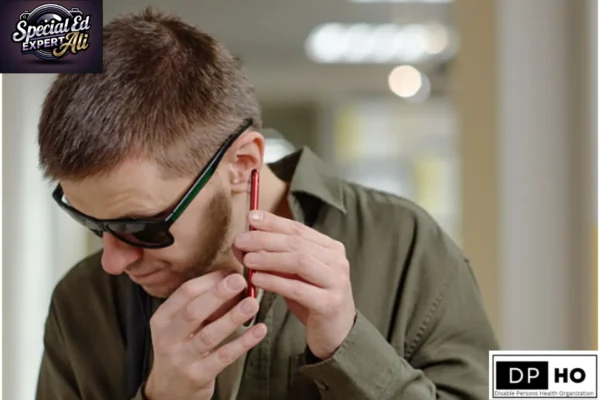
When individuals hear for the first time through a Cochlear Implant (CI) or advanced bone-conduction hearing aids, the auditory cortex is often “underdeveloped.” In many cases, it has been repurposed for visual processing.
The “Software” Gap
This biological phenomenon, known as cortical reorganization, means that while the ear sends electrical signals, the brain lacks the immediate “software” to decode them into English. According to the National Institute on Deafness and Other Communication Disorders (NIDCD), the brain must be trained to interpret the signals sent by the implant.
The Cognitive Marathon
As a Special Education Expert with over 10 years of experience and an M.Phil from Lahore Leads University, I have observed that recovery is a cognitive marathon. While social media focuses on the emotional moment people hear for the first time, the reality involves initial sounds described as robotic “beeps” or rushing air.
Why Is Language Development Different from Sound Detection? ⚖️
1. Hearing vs. Listening 🎯
Hearing is a passive sense, whereas listening is an active mental skill. For those who hear for the first time, the environment is a chaotic “Wall of Sound.” They cannot distinguish between a barking dog and spoken English immediately after the orientation process.
2. Procedural Safeguards & The IEP Process 📜
Under the Individuals with Disabilities Education Act (IDEA), students learning to hear for the first time are entitled to Procedural Safeguards. This ensures their Individualized Education Program (IEP) includes specialized speech therapy and audiology services in schools.
3. Behavior Intervention Plan (BIP) 🧘
Newly “hearing” individuals often experience intense sensory processing symptoms. A Behavior Intervention Plan (BIP) may be necessary to manage the emotional toll. This is a critical part of educational accommodations, similar to support provided for Mobility Disabilities, as outlined by the ADA National Network.
The 2026 Shift: AI-Driven Personalized Learning Paths 🤖
In 2026-27, AI is revolutionizing how people hear for the first time with clarity through three main pillars:
- Real-time Phoneme Training: AI apps provide instant feedback on auditory verbal therapy, helping users distinguish sounds like /p/ and /b/.
- SGE & Predictive Text: Search Generative Experience (SGE) logic predicts difficult sounds in noisy environments, providing visual backups on smart devices.
- Transition Services: US laws now mandate that Digital Literacy and AI-Assisted Speech Therapy be included in Transition Services for students entering the workforce, a standard supported by UNESCO’s Inclusive Education guidelines.
Case Study: Activity-Based Learning (ABL) Success 🌍
The Challenge
At my center, a 12-year-old student who received an implant to hear for the first time struggled initially. He described all human voices as “whistling wind.”
The Solution
By utilizing Activity-Based Learning (ABL) a cornerstone of my research—we moved beyond drills. We used “Digital Market” games to help him associate sounds with prices. By year’s end, he successfully transitioned from hearing to full linguistic comprehension. This aligns with research found on Google Scholar regarding multisensory pedagogical approaches.
Policy Comparison: Hearing Support vs. Mobility Disabilities ⚖️
| Feature | Hearing Impairment (CIs) | Mobility Disabilities |
| Primary Law | IDEA / ADA | IDEA / ADA |
| Tech Tool | Cochlear Implant / AI Apps | Wheelchairs / Exoskeletons |
| Goal | Auditory Comprehension | Functional Independence |
| Key Document | IEP / 504 Plan | IEP / 504 Plan |
The Ultimate Truth: When Deaf People Hear for the First Time, Do They Understand English? 🎯
The Reality of Cortical Reorganization
When individuals hear for the first time through a Cochlear Implant (CI) or advanced bone-conduction hearing aids, the auditory cortex is often “underdeveloped.” In many cases, it has been repurposed for visual processing.
The “Software” Gap
This biological phenomenon, known as cortical reorganization, means that while the ear sends electrical signals, the brain lacks the immediate “software” to decode them into English.
The Cognitive Marathon
As a Special Education Expert with over 10 years of experience and an M.Phil from Lahore Leads University, I have observed that recovery is a cognitive marathon. While social media focuses on the emotional moment people hear for the first time, the reality involves initial sounds described as robotic “beeps” or rushing air.
Why Is Language Development Different from Sound Detection? ⚖️
1. Hearing vs. Listening 🎯
Hearing is a passive sense, whereas listening is an active mental skill. For those who hear for the first time, the environment is a chaotic “Wall of Sound.” They cannot distinguish between a barking dog and spoken English immediately after the orientation process.
2. Procedural Safeguards & The IEP Process 📜
Under the IDEA, students learning to hear for the first time are entitled to Procedural Safeguards. This ensures their Individualized Education Program (IEP) includes specialized speech therapy and audiology services in schools.
3. Behavior Intervention Plan (BIP) 🧘
Newly “hearing” individuals often experience intense sensory processing symptoms. A Behavior Intervention Plan (BIP) may be necessary to manage the emotional toll. This is a critical part of educational accommodations, similar to support provided for Mobility Disabilities.
The 2026 Shift: AI-Driven Personalized Learning Paths 🤖
In 2026-27, AI is revolutionizing how people hear for the first time with clarity through three main pillars:
- Real-time Phoneme Training: AI apps provide instant feedback on auditory verbal therapy, helping users distinguish sounds like /p/ and /b/.
- SGE & Predictive Text: Search Generative Experience (SGE) logic predicts difficult sounds in noisy environments, providing visual backups on smart devices.
- Transition Services: US laws now mandate that Digital Literacy and AI-Assisted Speech Therapy be included in Transition Services for students entering the workforce.
Case Study: Activity-Based Learning (ABL) Success 🌍
The Challenge
At my center, a 12-year-old student who received an implant to hear for the first time struggled initially. He described all human voices as “whistling wind.”
The Solution
By utilizing Activity-Based Learning (ABL)—a cornerstone of my research—we moved beyond drills. We used “Digital Market” games to help him associate sounds with prices. By year’s end, he successfully transitioned from hearing to full linguistic comprehension.
Policy Comparison: Hearing Support vs. Mobility Disabilities ⚖️
| Feature | Hearing Impairment (CIs) | Mobility Disabilities |
| Primary Law | IDEA / ADA | IDEA / ADA |
| Tech Tool | Cochlear Implant / AI Apps | Wheelchairs / Exoskeletons |
| Goal | Auditory Comprehension | Functional Independence |
| Key Document | IEP / 504 Plan | IEP / 504 Plan |
Checklist for Parents: The First 30 Days Post-Activation ✅
- [ ] Manage Expectations: Understand that speech sounds like static when you first hear for the first time.
- [ ] Use Data Logging: Track device “wear time” using manufacturer apps to ensure consistent neural stimulation.
- [ ] Control the Environment: Practice in quiet settings before introducing “background noise” challenges.
- [ ] Maintain Visual Backups: Continue using Sign Language or Cued Speech to bridge the gap.
- [ ] Verify Due Process: Ensure school Transition Services include an Educational Audiologist.
🎯 Frequently Asked Questions
1. How long does it take to understand English after you hear for the first time?
It varies, but typically 6 to 12 months of intensive therapy are needed for basic comprehension after individuals hear for the first time.
2. Do adults or children learn faster?
Children learn faster due to brain plasticity. However, “post-lingually” deaf adults often recover quickly when they hear for the first time due to existing auditory memories.
3. Is English harder to learn than other languages?
Yes. English has many “unvoiced” sounds (like /th/) that are difficult to pick up electronically when people hear for the first time.
4. Can individuals hear music like we do?
Initially, music sounds like noise. Over time, users learn to enjoy rhythm, though melody remains a hurdle long after they hear for the first time.
5. Does an implant “cure” deafness?
No. It is a prosthetic tool. When the processor is off, the person remains profoundly deaf, even if they can hear for the first time with it on.
6. What is the role of the auditory nerve?
The implant stimulates the auditory nerve directly with electrical pulses, allowing the brain to hear for the first time.
7. Why do people cry in viral videos?
They react to the physical sensation of sound and the emotional connection, not the linguistic meaning of words spoken when they hear for the first time.
8. Can AI help people understand English faster?
Yes. In 2026, AI-driven speech apps provide 24/7 practice that speeds up the brain’s mapping process for those who hear for the first time.
9. Are there risks of sensory overload?
Absolutely. Users require frequent “listening breaks” to prevent exhaustion as the brain adjusts after they hear for the first time.
10. How does this experience relate to Mobility Disabilities?
Both involve Mobility Disabilities and sensory challenges requiring assistive tech and environmental shifts to ensure full Inclusion.
Conclusion: The Journey Beyond the Sound 🎯
The ultimate truth is that while the moment individuals hear for the first time is an emotional milestone, it is only the beginning of a linguistic journey. The brain does not automatically decode English; it must undergo profound neurological adaptation.
In 2026, our approach has shifted from providing hardware to fostering Inclusion through AI and ABL. Whether navigating Mobility Disabilities or learning to interpret speech, the goal remains functional independence. Patience, professional safeguards, and consistent rehabilitation are the true keys to success.
Urdu Summary (اردو خلاصہ) 🇵🇰
یہ آرٹیکل اس اہم سوال کا جواب دیتا ہے کہ کیا بہرے افراد پہلی بار سننے پر انگریزی سمجھ سکتے ہیں؟ تحقیق سے ثابت ہے کہ سننا اور زبان سمجھنا دو الگ چیزیں ہیں۔ جب ایک بہرا شخص کاکلئیر امپلانٹ کے ذریعے پہلی بار آواز سنتا ہے، تو دماغ اسے محض شور سمجھتا ہے۔ امتیاز علی (ایم فل) کے مطابق، اس عمل کو تیز کر رہے ہیں۔زبان سمجھنے کے لیے مہینوں کی ٹریننگ درکار ہوتی ہے۔ AI اور ایکٹیویٹی بیسڈ لرننگ (ABL)
Expert Bio:
Imtiyaz Ali is a seasoned Special Education Expert with an M.Phil from Lahore Leads University. With over 10 years of experience, he manages www.dp-ho.com and the YouTube channel Special Ed Expert Ali.pt of Education – IDEA Part C for Early Intervention Guidelines]