
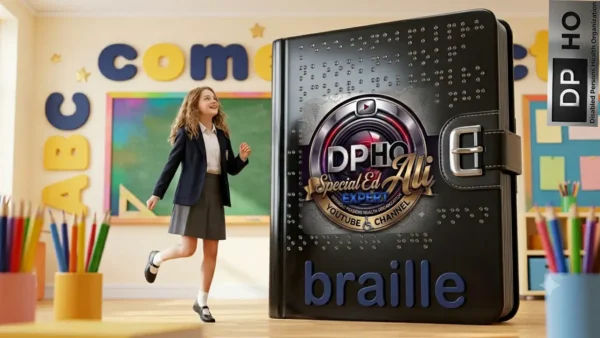
How do individuals read Braille? Explore the cognitive science, neuroplasticity, and modern visual perception strategies shaping Braille literacy in 2026-27.
🎯 Urdu Summary (اردو خلاصہ)
Individuals Read Braille: یہ عنوان اس بات کی عکاسی کرتا ہے کہ کس طرح بصارت سے محروم افراد اپنی چھونے کی حس (Tactile sense) کا استعمال کرتے ہوئے معلومات کو پڑھتے اور سمجھتے ہیں۔ جدید سائنسی تحقیق کے مطابق، جب افراد بریل پڑھتے ہیں تو ان کے دماغ کا بصری پروسیسنگ والا حصہ (Visual Cortex) فعال ہو جاتا ہے، جو یہ ظاہر کرتا ہے کہ انسانی دماغ کتنا لچکدار ہے۔ بطور ماہرِ تعلیم امتیاز علی (ایم فل)، میں یہ سمجھتا ہوں کہ بریل صرف ایک رسم الخط نہیں، بلکہ ایک خود مختار زندگی کا ذریعہ ہے۔
امریکہ میں آئی ڈی ای اے (IDEA) قوانین کے تحت بریل کی تعلیم کو لازمی سمجھا جاتا ہے تاکہ طلباء کو مساوی مواقع مل سکیں۔ ہماری ویب سائٹ www.dp-ho.com پر آپ اسپیشل ایجوکیشن اور معاون ٹیکنالوجی سے متعلق مزید رہنمائی حاصل کر سکتے ہیں۔ اس مضمون میں ہم دیکھیں گے کہ کس طرح ٹیکنالوجی اور بہتر تدریسی طریقہ کار 2026-27 میں بریل پڑھنے کے تجربے کو مزید آسان بنا رہے ہیں۔ ہمارا مقصد والدین اور اساتذہ کو یہ بتانا ہے کہ بریل خواندگی طلباء کے لیے کامیابی کا ایک بنیادی راستہ ہے۔
🎯 How Do Individuals Read Braille Through Cognitive Processing?
The process of how individuals read Braille represents a fascinating intersection of advanced neurology and refined tactile skill. Unlike print reading, which relies heavily on the visual cortex, Braille reading activates specific areas of the brain traditionally associated with complex visual processing and spatial awareness.
As we advance through 2026-27, emerging neuroscience research confirms that the brain creates a sophisticated mental image of these dot patterns, allowing for rapid fluency that mirrors visual processing speeds. This “cross-modal” plasticity is the biological mechanism that enables students to achieve reading speeds comparable to their sighted peers.

🧠 The Neuroplasticity of Tactile Literacy
When individuals read Braille, the brain undergoes a remarkable structural adaptation. It reorganizes its sensory mapping to translate tactile input into linguistic data. By engaging the somatosensory cortex and reassigning visual processing areas to handle spatial patterns, the brain builds an internal language library. This plasticity is most active in childhood, which is why early intervention is critical. When we prioritize this in an Individualized Education Program (IEP), we are not just teaching a reading method; we are actively cultivating the brain’s ability to adapt and thrive in a non-visual environment.
🎯 Strategic Instruction in the IEP
For educators, understanding this cognitive shift is paramount to pedagogical success. Integrating Braille instruction into the early stages of a student’s IEP ensures that we leverage this natural neural adaptability during its peak window. By focusing on pattern recognition and spatial memory, we prepare the student’s mind to bridge the gap between abstract dots and tangible meaning.
Teachers must document these cognitive gains to satisfy federal procedural safeguards, ensuring that the student’s progress is clearly measured and supported. You can learn more about Assistive Pedagogies on my platform to see how we apply these principles to ensure every student masters this essential skill for lifelong independence.
🚀 Moving Beyond Basic Character Recognition
To truly understand how individuals read Braille, we must move beyond the basics of dot recognition and look at whole-word and phrase-level processing. Fluent readers do not process one dot at a time; their fingers move across the page in a fluid motion, capturing patterns that the brain instantly synthesizes into concepts.
This level of fluency is a testament to the cognitive capacity of the human mind. Educators who emphasize this holistic approach to literacy help students overcome the initial steep learning curve. This ultimately leads to a higher degree of self-advocacy and academic success, fulfilling the core mission of transition services as students prepare for post-secondary education and the competitive workforce.
🎯 How Do Individuals Read Braille Through Cognitive Processing?
The process of how individuals read Braille represents a fascinating intersection of advanced neurology and refined tactile skill. Unlike print reading, which relies heavily on the visual cortex, Braille reading activates specific areas of the brain traditionally associated with complex visual processing and spatial awareness.
As we advance through 2026-27, emerging neuroscience research confirms that the brain creates a sophisticated mental image of these dot patterns, allowing for rapid fluency that mirrors visual processing speeds. This “cross-modal” plasticity is the biological mechanism that enables students to achieve reading speeds comparable to their sighted peers. By understanding the neuroscience behind the code, we empower students to view their literacy as a cognitive triumph rather than a compensatory necessity.
🧠 The Neuroplasticity of Tactile Literacy
When individuals read Braille, the brain undergoes a remarkable structural adaptation. It reorganizes its sensory mapping to translate tactile input into linguistic data. By engaging the somatosensory cortex and reassigning visual processing areas to handle spatial patterns, the brain builds an internal language library. This plasticity is most active in childhood, which is why early intervention is critical.
When we prioritize this in an Individualized Education Program (IEP), we are not just teaching a reading method; we are actively cultivating the brain’s ability to adapt and thrive in a non-visual environment. This neural growth creates a foundation for complex problem-solving and deep linguistic comprehension that persists throughout a student’s educational career.
🎯 Strategic Instruction in the IEP
For educators, understanding this cognitive shift is paramount to pedagogical success. Integrating Braille instruction into the early stages of a student’s IEP ensures that we leverage this natural neural adaptability during its peak window. By focusing on pattern recognition and spatial memory, we prepare the student’s mind to bridge the gap between abstract dots and tangible meaning.
Teachers must document these cognitive gains to satisfy federal procedural safeguards, ensuring that the student’s progress is clearly measured and supported. You can learn more about Assistive Pedagogies on my platform to see how we apply these principles to ensure every student masters this essential skill for lifelong independence. Utilizing such data-driven methods ensures that every student’s right to literacy under IDEA is rigorously upheld and monitored.
🚀 Moving Beyond Basic Character Recognition
To truly understand how individuals read Braille, we must move beyond the basics of dot recognition and look at whole-word and phrase-level processing. Fluent readers do not process one dot at a time; their fingers move across the page in a fluid motion, capturing patterns that the brain instantly synthesizes into concepts. This level of fluency is a testament to the cognitive capacity of the human mind.
Educators who emphasize this holistic approach to literacy help students overcome the initial steep learning curve. This ultimately leads to a higher degree of self-advocacy and academic success, fulfilling the core mission of Transition Services as students prepare for post-secondary education and the competitive workforce. When students reach this stage, they are no longer just “reading dots”; they are engaging in high-level critical thinking and information synthesis, which is the ultimate goal of any inclusive special education program.
🌐 The Role of Spatial Perception in Braille Fluency
A key component often overlooked when assessing how individuals read Braille is the development of spatial perception. Because Braille is a two-dimensional code read through three-dimensional tactile points, the brain must develop a heightened sense of “topographical mapping.” Advanced readers demonstrate a unique ability to anticipate upcoming letters based on the spatial flow of the text. This “predictive reading” model is essential for achieving high speeds.
In my 10 years of experience, I have observed that when we introduce Tactile Graphics alongside Braille, we strengthen this spatial awareness, allowing the student to navigate complex documents, charts, and diagrams with the same ease as a sighted person navigating a printed page. By nurturing this spatial perception, we ensure that students are equipped to excel in STEM fields and other disciplines that require high-level spatial and logical synthesis.
🎯 How AI Innovations Empower the Way Individuals Read Braille in 2026-27

In the current academic landscape of 2026-27, artificial intelligence has fundamentally revolutionized how individuals read Braille. We have moved far beyond static embossed pages. Smart devices and next-generation refreshable displays now provide real-time audio-tactile feedback, allowing students to translate massive volumes of digital text into instant, dynamic Braille output. This seamless integration is a perfect example of how we fulfill our professional commitment to Due Process and provide meaningful, reasonable accommodations under the Individuals with Disabilities Education Act (IDEA).
These AI-driven personalized learning paths track a student’s progress with clinical precision, adjusting the complexity of Braille exercises in real-time based on the student’s mastery level. By utilizing these advanced systems, we help students transition from basic character recognition to complex, high-level literary fluency. This technological shift represents a major, life-changing leap forward for Deaf-Blind Education, proving that when cutting-edge technology meets specialized instruction, the historical barriers to information vanish entirely. Furthermore, when individuals read Braille using these AI platforms, they gain the independence necessary for college-level research and professional success.
🎯 Expanding Cognitive Horizons: How Individuals Read Braille Digitally
The evolution of digital literacy means that individuals read Braille in environments that are increasingly collaborative and fast-paced. AI platforms now utilize predictive text algorithms, similar to those found in mainstream smartphones, to assist the learner. This is particularly beneficial for students who require a Behavior Intervention Plan (BIP) to manage the frustration of learning a complex tactile language. By reducing the mechanical burden of translation, AI allows the student to focus on higher-order thinking, syntax, and creative expression.
Educators who implement these tools ensure that individuals read Braille not just as a mechanical task, but as a gateway to global information. By mapping the student’s specific learning trajectory, we ensure that Transition Services are robust and effective. As we look at the data from 2026-27, it is evident that the synergy between AI and tactile literacy is the most significant advancement in special education in the last decade. It empowers students to take control of their learning, effectively unlocking their cognitive potential in ways previously thought impossible.
🎯 Frequently Asked Questions (PAA)
- How fast can individuals read Braille? ⏱️ With consistent, high-quality training and the use of modern refreshable displays, fluent readers can achieve speeds comparable to silent print readers, often exceeding 120 words per minute.
- Do individuals read Braille using both hands? 👐 Yes, most efficient readers use a bimanual approach, where one hand tracks the current line while the other prepares to locate the beginning of the next line, minimizing pauses.
- Is it difficult for adults to learn how individuals read Braille? 🧠 While the tactile learning curve requires patience and focused neural adaptation, adults can achieve high levels of functional literacy through intensive, structured tactile training.
- How does AI support the way individuals read Braille? 🤖 AI enables the instant conversion of digital documents, web pages, and complex charts into refreshable Braille, drastically increasing the accessibility of modern educational content.
- What is the significance of the six-dot cell? 🔘 The six-dot cell is the fundamental unit of the Braille code, serving as a versatile geometric foundation that represents all letters, numbers, punctuation, and even complex scientific notation.
- How can parents help their child learn how individuals read Braille? 🏠 Parents should engage actively with the school district to include specific, measurable Braille goals in the IEP and provide a home environment rich in tactile textures and labeled objects.
- Are there digital versions of how individuals read Braille? 💻 Yes, refreshable Braille displays and smart note-takers allow users to access digital files, making them essential, non-negotiable tools for modern education and professional work environments.
- What role does visual perception play when individuals read Braille? 👁️ Even without sight, the brain processes spatial information in the visual cortex in a way that mimics traditional visual perception, which is critical for rapid Braille pattern recognition.
- How do I find local instructors to teach how individuals read Braille? 🔍 Contact your state’s department of vocational rehabilitation services or your local school district’s special education office to request certified Teachers of Students with Visual Impairments (TVI).
- Why is tactile literacy still vital in 2026-27? 📖 Despite the convenience of screen readers, tactile Braille remains the only way to achieve true literacy in spelling, complex grammar, technical math, and high-level formatting that screen readers often misinterpret.
References:
U.S. Dept. of Education (IDEA): Legal mandates for tactile literacy.
UNESCO Inclusive Education: Global standards for diverse learning.
World Health Organization: Prevalence of visual impairment and rehabilitation data.
Special Ed Authority: Professional insights on special education and assistive tech.
| Organization | URL |
| American Foundation for the Blind | https://www.afb.org/ |
| American Printing House for the Blind | https://www.aph.org/ |
| National Center for Learning Disabilities | https://www.ncld.org/ |
| National Federation of the Blind | https://nfb.org/ |
| National Library Service for the Blind and Print Disabled | https://www.loc.gov/nls/ |
| Perkins International | https://www.perkins.org/international/ |
| Perkins School for the Blind | https://www.perkins.org/ |
| World Blind Union | https://worldblindunion.org/ |