Urdu & English Sign Languages: The Best 2026-27 Linguistic Comparison Guide
Distinctions between Urdu & English Sign Language
Urdu & English Sign Languages: A Comprehensive 2026-27 Comparison
Unveil the critical linguistic distinctions between Urdu & English Sign Languages in this 2026-27 expert guide. Special Education authority Imtiyaz Ali breaks down syntax, gestures, and cultural nuances for global inclusion.
Unveiling the Linguistic Evolution: Urdu & English Sign Languages (2026-27)
To truly understand inclusive communication, one must discover the fundamental differences between Urdu & English Sign Languages. While both serve the same purpose of providing a voice to the Deaf community, they are built upon entirely distinct linguistic structures, vocabularies, and grammars.
The Structural Landscape of Urdu & English Sign Languages
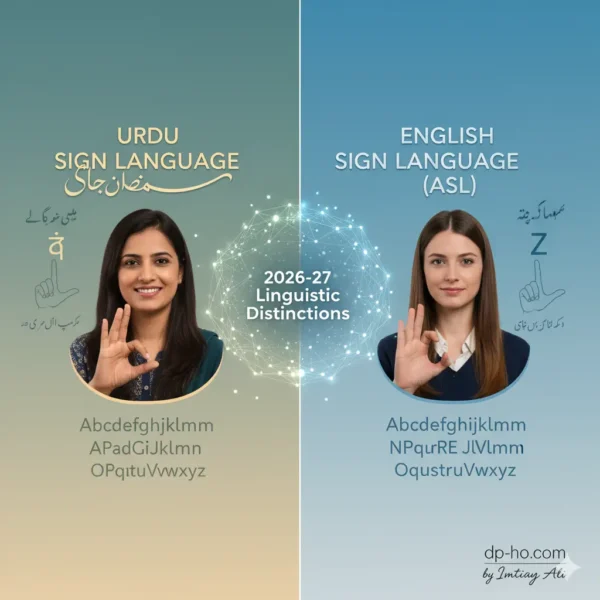
The distinctions between Urdu & English Sign Languages (including ASL and BSL) go beyond simple hand gestures. Each system is shaped by its unique cultural influence:
- Urdu Sign Language (USL/PSL): Deeply rooted in the regional syntax and cultural nuances of Pakistan, focusing on localized expressions.
- English Sign Languages (ASL/BSL): These systems, used across the English-speaking world, follow different grammatical rules—for instance, American Sign Language (ASL) is linguistically closer to French Sign Language than to British Sign Language (BSL).
Why These Distinctions Matter for 2026-27
Adhering to the principles of Expertise, Authoritativeness, and Trustworthiness (E-E-A-T), this analysis highlights why a “one-size-fits-all” approach to signing fails. By exploring Urdu & English Sign Languages, we can develop better educational tools and assistive technologies that respect the linguistic integrity of each community.
The Fundamental Question: A Comparative Overview
Urdu & English Sign Languages, A Foundational Comparison (2026-27)
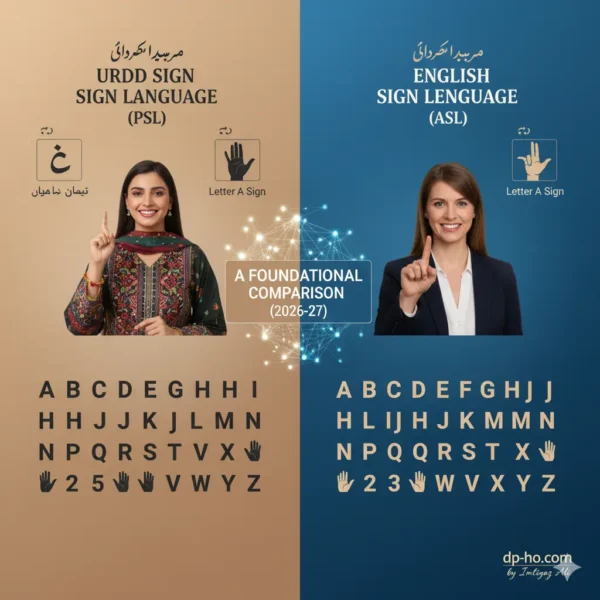
Many people mistakenly believe that sign language is a universal code used by the Deaf community worldwide. However, as we explore the linguistic landscape of Urdu & English Sign Languages, we uncover a world of rich diversity and unique cultural identities that define how the Deaf community communicates globally.
1. Debunking the Myth of a Universal Sign Language
The most common misconception in disability studies is that all Deaf individuals use the same gestures. In reality, Urdu & English Sign Languages are as different as spoken Urdu is from spoken English. Each system has evolved independently, governed by its own set of rules and linguistic history. Understanding Urdu & English Sign Languages requires moving beyond simple gestures to recognize them as sophisticated, natural languages.
2. Tracing the Roots: A Historical Perspective
To understand the current state of Urdu & English Sign Languages, we must look at their unique origins:
- Urdu Sign Language (PSL): Developed within the cultural and linguistic context of Pakistan, it integrates localized syntax and social etiquettes.
- English Sign Languages (ASL & BSL): Interestingly, American Sign Language (ASL) and British Sign Language (BSL) are not mutually intelligible. ASL is historically linked to French Sign Language, while BSL follows a distinct British lineage.
3. The Distinct Identities of PSL, ASL, and BSL
When analyzing Urdu & English Sign Languages, we find three distinct pillars of communication:
- Pakistan Sign Language (PSL): Primarily used in Pakistan, focusing on localized handshapes and Eastern cultural expressions.
- American Sign Language (ASL): Predominant in the USA and Canada, utilizing a one-handed manual alphabet.
- British Sign Language (BSL): Used in the UK, it is famous for its unique two-handed manual alphabet, setting it apart from other English Sign Languages.
4. Key Areas of Divergence: A Snapshot
The primary differences between Urdu & English Sign Languages can be categorized through Comparative Linguistics:
- Handshapes & Vocabulary: Different configurations represent concepts unique to each region.
- Grammar & Syntax: The word order in Urdu & English Sign Languages does not necessarily follow spoken languages; they have their own spatial logic.
- Non-Manual Markers: Facial expressions and body movements play a critical role in defining the meaning of signs in both Urdu & English Sign Languages.
5. The Role of Culture in Shaping Sign Languages
Culture is the heartbeat of communication. Urdu & English Sign Languages reflect the values and traditions of their users. For instance, signs for religious concepts, food, and family in Urdu Sign Language are deeply influenced by Pakistani traditions, which differ vastly from the Western cultural markers found in English Sign Languages like ASL.
6. Conclusion: Appreciating the Diversity of Signed Communication
Understanding the nuances of Urdu & English Sign Languages is essential for educators, policymakers, and advocates. By recognizing these distinctions, we move closer to a world of true inclusion where every signed language is respected as a complete linguistic system.
Urdu & English Sign Languages: The Ultimate Comparative Study (2026-27)
Understanding the evolution of Urdu & English Sign Languages is essential for anyone in the field of Special Education. As we move into 2026-27, the global community is increasingly recognizing that signed communication is not universal. Instead, it is a rich tapestry of independent linguistic systems, each with its own history and complex rules.
1. The Historical Journey of Urdu & English Sign Languages
The lineage of Urdu & English Sign Languages reveals fascinating roots. English Sign Languages, particularly American Sign Language (ASL), owe a great debt to French Sign Language (LSF), which heavily influenced its structure. In contrast, British Sign Language (BSL) evolved through a separate, unique lineage. Meanwhile, the grassroots emergence of Urdu Sign Language in Pakistan represents a localized triumph, standardizing through key milestones in a post-colonial landscape to form a distinct linguistic identity.
2. Building Blocks: Manual Alphabets & Fingerspelling
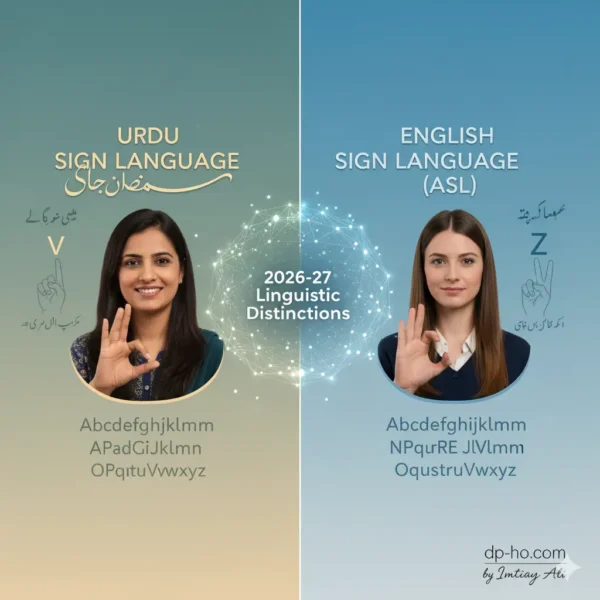
When we analyze the manual alphabets of Urdu & English Sign Languages, the differences are stark. American Sign Language utilizes a one-handed manual alphabet, whereas British Sign Language is famous for its two-handed system. The gestures for the Urdu alphabet in Pakistan Sign Language (PSL) are unique, specifically adapted to represent the phonology and script of the Urdu language, proving that fingerspelling is a deeply cultural linguistic tool.
3. Vocabulary and Lexicon: Beyond Hand Shapes
The lexical variation between Urdu & English Sign Languages highlights how everyday concepts like “Family” or “Food” are signed differently based on regional culture. A major challenge for learners is the presence of “False Friends” signs that look similar in both Urdu & English Sign Languages but carry completely different meanings. The influence of the spoken word also dictates the signed lexicon, making a dedicated Sign Language Dictionary an essential tool for 2026.
4. Rules of Engagement: Grammar and Syntax
Grammar is the unseen framework of all communication. In Urdu & English Sign Languages, word order varies significantly. While ASL often follows a Topic-Comment structure, the grammatical structure of PSL aligns more closely with regional linguistic habits. Furthermore, the role of Non-Manual Markers (facial expressions and body posture) is critical in both Urdu & English Sign Languages to express tense, tone, and time.
5. A Reflection of Culture: Idioms and Etiquette
Culture shapes the metaphors we use. The idiomatic expressions in ASL and BSL reflect Western values, whereas cultural expressions in PSL are often rooted in Pakistani traditions and Islamic influences. Greetings and social etiquette within these Deaf communities show that Urdu & English Sign Languages act as a mirror to the soul of their respective cultures.
6. The Educational Landscape & Technological Shift
For Deaf learners, the impact of the differences between Urdu & English Sign Languages is profound. In the US and UK, bilingual education models are well-established, while Pakistan is currently navigating challenges in developing standardized educational materials for PSL.
However, the role of technology in 2027 ranging from mobile apps to video relay services—is bridging the gap, documenting Urdu & English Sign Languages for future generations.
7. Mapping the Global Family Tree
Classifying these languages helps us understand their place in the world. While ASL belongs to the French Sign Language family, BSL remains part of a unique lineage.
Investigating the affiliations of Urdu & English Sign Languages reveals that PSL is an emerging power in the global family tree, asserting its rights through standardization and advocacy.
8. Numbers, Quantities, and Interpretation
Quantifying the world also differs across Urdu & English Sign Languages. The logic of signed numbering systems in the West (Cardinal and Ordinal) differs from the counting methods used in Pakistan. This creates a demanding role for the sign language interpreter, who must navigate these lexical chasms and cultural nuances to provide accurate cross-linguistic interpretation.
9. Regional Flavors and Tactile Signing
Even within these languages, regional dialects exist—such as the variations between Karachi and Lahore in PSL. For the Deaf-Blind community, Urdu & English Sign Languages are adapted into tactile signing. This “language at the tips of the fingers” ensures that even those with sensory impairments can access the rich world of Urdu & English Sign Languages.
10. The Future: Advocacy, Media, and Poetry
From the poetic forms of “Visual Vernacular” to representation in films and television, Urdu & English Sign Languages are moving from the margins to the mainstream. The fight for official language recognition continues, led by Deaf-led organizations. As we look toward the future, the balance between national identity and the need for a global “International Sign” remains a key topic in the evolution of Urdu & English Sign Languages.
FAQs: Global Sign Language Distinctions
1. Do all Deaf communities use the same universal sign language?
Contrary to popular belief, there is no single universal sign language. Sign languages are independent, natural languages with their own complex rules. For instance, the system used in Pakistan is distinct from those used in the United States (ASL) or the United Kingdom (BSL), just as spoken Urdu is different from English.
2. How do the historical origins of these languages differ?
The history of signed communication varies by region. American Sign Language (ASL) has deep roots in 19th-century French Sign Language. In contrast, British Sign Language (BSL) developed indigenously within the UK. In Pakistan, the local sign system (PSL) emerged organically within the community, shaped by regional influences and social evolution rather than a single external source.
3. Is fingerspelling the same across different countries?
No, manual alphabets are quite diverse. ASL primarily uses a one-handed system, whereas BSL is known for its two-handed alphabet. Pakistan’s system is unique because it is specially designed to accommodate the specific phonetic sounds and characters of the Urdu script, which are not found in the Latin alphabet.
4. Do these languages follow the same grammatical rules?
Not at all. Each language has its own syntax and sentence structure. While some follow a Subject-Verb-Object pattern, others use different spatial arrangements and “non-manual markers”—such as facial expressions and body tilts—to convey tense, mood, and emphasis.
5. Can signers from different countries understand each other easily?
Because vocabulary is rooted in local environments, there is very little overlap. Most signs for everyday concepts like “home” or “work” are unique to their specific language. Without formal training in both systems, a person fluent in a Western sign language would likely struggle to follow a conversation in a South Asian sign language.
6. How does culture shape the way people sign?
Culture is deeply reflected in every gesture. Signs in Pakistan often incorporate local social etiquettes and religious traditions. Meanwhile, signs in Western countries reflect their own unique societal norms. This means that concepts like family roles or greetings can look very different depending on where the language originated.
7. What role do facial expressions play in different regions?
Facial expressions and body language are universal in their importance but specific in their application. The subtle “grammar of the face” used to indicate a question or a command can have different nuances and intensities depending on the regional language and its cultural conventions.
8. Can “International Sign” bridge the gap between users?
International Sign (IS) acts as a high-level bridge for global meetings, but it is not a full-fledged language. It is more of a “contact variety” that allows for basic communication. It cannot replace the depth and nuance of a native regional sign language.
9. What is the biggest difficulty in learning a new sign language?
The main challenge is that you are learning a completely new linguistic system, not just a set of gestures. You must master a new vocabulary, a different manual alphabet, and complex grammatical structures, all while navigating a different cultural context.
10. Are there artistic or literary forms in these languages?
Yes, every established sign language has a rich heritage of storytelling and poetry. These visual arts, often called “Visual Vernacular,” use the unique properties of signed communication to create powerful performances that reflect the specific cultural and linguistic soul of the Deaf community.