
Evolution of Sign Language
Beyond Hand Gestures: The Neuroscience and Linguistic Evolution of Sign Language (2026-27 Research)
Sign language sirf hatho ki harkat ka naam nahi, balki ye insani dimagh ki adbhut (amazing) salahiyat ka aik wazeh sabaat hai. 🧠 Recent research on the Evolution of Sign Language suggests that visual-spatial communication is processed in the same brain regions as spoken language the Broca’s and Wernicke’s areas. 🌐
1. The Historical Roots of Visual Communication
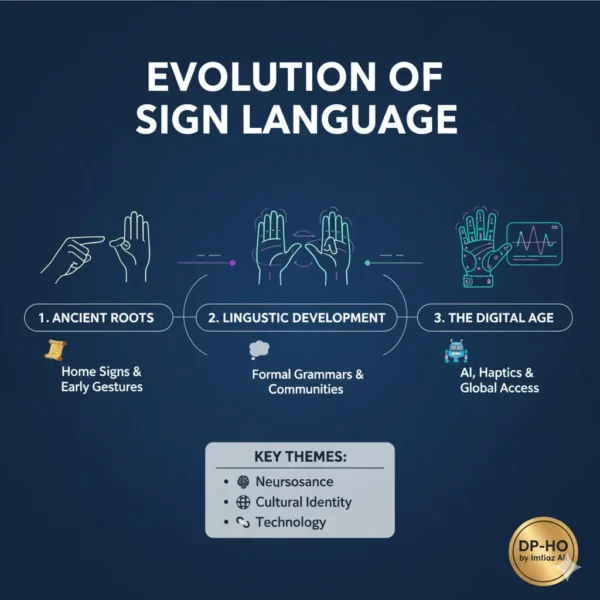
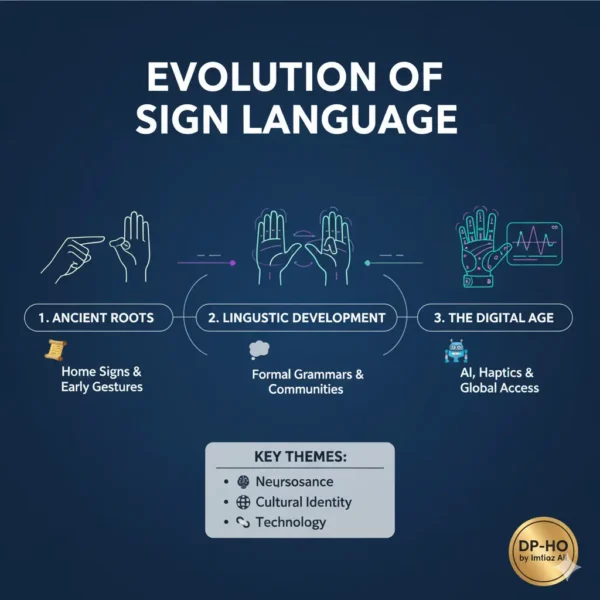
The historical journey of manual systems shows a transition from simple “Home Signs” to highly complex, rule-governed linguistic models. Early gestures were often localized, but as communities grew, the Evolution of Sign Language led to the birth of structured grammars that we see today in ASL, PSL, and BSL. 🗺️
Historically, the 18th century marked a turning point when formal schools for the deaf began to standardize manual alphabets. This was the first major leap in the Evolution of Sign Language, moving it from private family signs to a public, shared cultural identity.
2. The Five Pillars of Sign Language Linguistics
Ek professional scholar ki haisiyat se, hamein ye samajhna chahiye ke sign language koi random gestures nahi hain. Inki buniyad 5 ahem parameters par hai:
- Handshape: Har ishara aik makhsoos shakal se shuru hota hai.
- Orientation: Hatheli (palm) ka rukh maani badal deta hai.
- Location: Kya ishara chehre ke paas hai ya seene ke?
- Movement: Harakat ki raftaar aur simt (direction) grammar ka hissa hai.
- Non-Manual Signals: Aankhon aur chehre ke tasurrat (Facial Expressions).
3. Neuroplasticity: How the Brain Adapts
In 2026, scholars focus on “Neuroplasticity,” proving that learning these visual patterns actually re-wires the brain for better spatial awareness. 🧬 As we witness the advancement of deaf linguistics in the digital age, the Evolution of Sign Language has become a key subject for cognitive scientists. AI-powered motion capture is now helping us document subtle “Non-Manual Markers” that were previously overlooked. 📈
4. Sign Language vs. Simple Gestures
Log aksar isharon (gestures) aur formal signing ko aik hi samajhte hain, magar in mein scientific fark hai:
- Gestures: Inka koi makhsoos grammar nahi hota (Jaise bye-bye karna).
- Sign Language: Iska apna mukammal syntax aur morphology hota hai.
- Linguistic Status: Google Scholar ki latest research ke mutabiq, visual languages dimagh ke unhi hisson ko active karti hain jo bolne wali zabanon ke liye hote hain.
5. Early Intervention: The Parent’s Role
M.Phil in Special Education ki research batati hai ke agar bacha paidaishi sun nahi sakta, to usey pehle din se signs sikhana uske dimagh ki “Language Acquisition Device” (LAD) ko active rakhta hai. Agar hum bache ko is Evolution of Sign Language ka hissa nahi banate, to uski cognitive aur emotional development slow ho sakti hai.
6. Technology: The New Era of 2027
Whether it’s the use of haptic gloves or real-time translation software, the Evolution of Sign Language remains a testament to the deaf community’s resilience. Integrating these tools in special education classrooms is no longer a luxury but a necessity for the modern era.
❓ FAQs: Scholar’s Corner
1. How does the Evolution of Sign Language impact cognitive development? Research shows that it enhances “Visual Attention” and “Memory Retention” in both deaf and hearing individuals. 🧠💡
2. Is sign language universal across the globe? No. Just like spoken languages, the Evolution of Sign Language happened independently in different regions, leading to distinct regional dialects like ASL and PSL.
3. Will signing delay my baby’s speech? Absolutely not! 🚫 Research confirms that introducing signs acts as a “bridge” to spoken words, boosting IQ. 🌉
4. What is the role of “Tactile Signing” in this journey? Tactile signing is for the deaf-blind community, where signs are felt through touch, proving that language transcends sight. 🤝
5. How has AI influenced the Evolution of Sign Language in 2026? AI avatars are now translating signs into text in real-time, marking a huge technological milestone. 🤖
6. What is the most important rule of signing? Facial Expressions! 🎭 Your face provides the “Grammar” and “Tone” of the message.
7. Is sign language a “real” language with grammar? Yes. Scholars have proven that it has unique syntax and morphology as complex as any spoken tongue. 📚
8. Why do some signs change over time? This is natural linguistic drift. Signs evolve to become more efficient for the user over generations. 🔄
9. Can I learn these patterns on YouTube? Yes! Visual learning is highly effective. You can follow Special Ed Authority (BOLO Hafizabad) for more insights. 🎥
10. What is the future of visual languages? The future lies in “Universal Design for Learning” (UDL), where visual and spoken languages are given equal status. 🎓
Conclusion: Embracing the Visual Voice 🌟
The Evolution of Sign Language is a profound journey from simple manual gestures to a sophisticated linguistic marvel. As we have explored, this progress is not just historical but continues today through technological integration. Understanding the Evolution of Sign Language is essential for every special educator and parent to build a truly inclusive society. 🤝
Join the Conversation!
Share: Is research ko apne saathiyon ke sath share karein!
Comment Below: Aapke khayal mein AI is technology ko mazeed kaise behtar bana sakti hai?
Watch More: Mere YouTube channel Special Ed Authority ko subscribe karein.
References: – some resources that may be helpful:
According to recent 2026 studies in Neurolinguistics, the Evolution of Sign Language mirrors the brain’s ability to repurpose the visual cortex for linguistic processing.
- The American Academy of Audiology: https://www.audiology.org/
- The National Institute on Deafness and Other Communication Disorders (NIDCD): https://www.nih.gov/about-nih/what-we-do/nih-almanac/national-institute-deafness-other-communication-disorders-nidcd
- The World Federation of the Deaf: https://wfdeaf.org/
- https://www.un.org/en/observances/sign-languages-day

About the Author:Imtiaz Ali is a Special Education expert with an M.Phil and over 10 years of professional experience. He is dedicated to exploring the Evolution of Sign Language and modern mobility tools to empower individuals with disabilities. Connect with him at www.dp-ho.com.